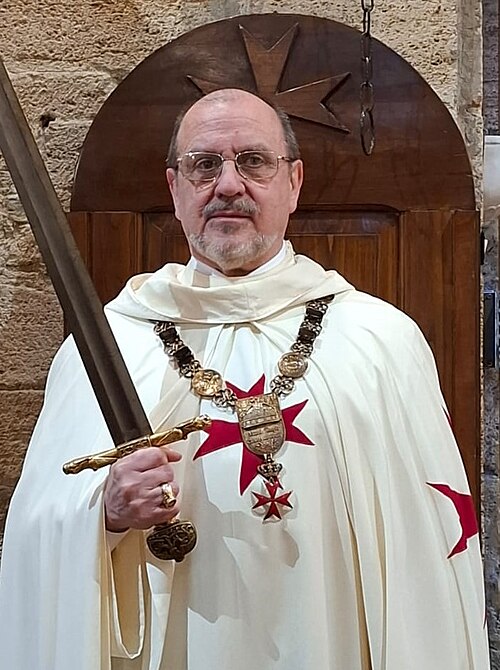
The Militia Templi — formally the Christi Pauperum Militum Ordo (“Order of the Poor Knights of Christ”) — is a lay Catholic order founded in 1979 by Count Marcello Alberto Cristofani della Magione, a Tuscan nobleman with a longstanding involvement in the Scouting movement. The order was formally established by public deed notarized by Dr. Alberto Chieffi in Florence on May 17, 1979. Its purpose was to offer young people, already formed in the spirit of chivalry through the Scout groups Cristofani had founded in Siena and Poggibonsi, a way of life inspired by the ideal of the “Knight” as described by St. Bernard of Clairvaux in his treatise Liber ad Milites Templi de laude novae Militiae (In Praise of the New Knighthood).
Rather than being a purely ceremonial or honorary body, the order was conceived around a genuine “Rule,” emphasizing lifestyle over titles — a true Christian chivalry, revived and adapted for the modern era.
Civil and canonical recognition. The Militia was civilly recognized on September 21, 1979, by Decree n. 613 of the President of the Regional Council of Tuscany, and it was later canonically erected on September 8, 1988. On November 18, 1990, the Ordinary of Siena, Monsignor Bonicelli, approved the order’s Rule under the name “Regola dei Poveri Cavalieri di Cristo dell’Ordine della Milizia del Tempio,” adapted from the ancient Templar Rule for contemporary life. Today it operates as a Catholic private association of the faithful that celebrates its liturgy according to the traditional 1962 form, often called the Tridentine Mass, under the authority of the Archdiocese of Siena-Colle di Val d’Elsa-Montalcino.
A historic seat. On January 20, 1979, the medieval Castello della Magione in Poggibonsi (Siena) — a Romanesque complex that had belonged to the Templars until their suppression in 1312, then passed to the Hospitallers, and later to a succession of private owners including the Corsini family — was acquired by Cristofani della Magione, who donated it to the newly forming Militia Templi as its patrimonial endowment and Magistral Seat. The castle, described by art historians as one of the most complete surviving medieval hospital complexes in Western Europe, underwent extensive restoration after the donation and remains the order’s seat and spiritual center to this day.
No claim of lineage. Notably, the order makes no claim of direct historical descent from the medieval Knights Templar, holding that such claims — when made by other groups — are both historically and canonically false. Its self-understanding is that of a modern chivalric revival rooted in Templar spirituality rather than an unbroken institutional continuation.
Leadership. Cristofani della Magione served as Grand Master for life in recognition of his role as founder and benefactor, until his death, after which Dom. Andrea Conti was elected as the order’s second Grand Master in March 2025.